

School Safety Radios in 2026: Alyssa's Law, FCC Compliance & Best Systems
TwoWayRadioGear.com · Authorized Motorola Solutions Dealer · 25+ Years in Two-Way Radio Communications
Covers Alyssa's Law, COPS SVPP Grants, FCC Licensing & Digital Migration
Published by TwoWayRadioGear.com · Authorized Motorola Solutions Dealer · 25+ Years in Two-Way Radio Communications
Updated for Q2 2026 · Covers Alyssa's Law, COPS SVPP Grants, FCC Licensing & Digital Migration
A teacher presses the call button on her analog walkie-talkie from a basement stairwell. Static. She tries again. Nothing. The signal can't penetrate two floors of concrete and rebar. The front office has no idea there's a problem, because the radio she's holding was designed for a restaurant floor. Not for a 200,000-square-foot campus with three buildings, underground corridors, and a stadium.
This plays out in thousands of K-12 campuses every single day. Not during an active emergency. During the normal operating day. Dead zones in stairwells. Channels overwhelmed during dismissal. Batteries that die by fifth period. Radios so bulky that teachers leave them in a drawer instead of carrying them.
And the worst part: most administrators don't know their communication system has failed until it's needed most.
The uncomfortable truth for 2026: Eleven states have enacted Alyssa's Law, requiring silent panic alert systems in every school building. Eighteen more introduced similar legislation in 2025 alone. Federal grant programs distribute over $73 million annually for school safety upgrades, and two-way radios are explicitly listed as an approved expenditure. If your school is still running on analog walkies, unlicensed FRS radios, or personal cell phones, you're not just behind on technology. You're exposed on compliance, vulnerable in a crisis, and leaving federal money on the table.
We built this guide because we've spent 25 years programming, deploying, and supporting two-way radio fleets for schools. We've seen the same mistakes cost districts time, money, and safety. What follows is a complete 2026 framework for school administrators, SROs, and district IT directors who need a communication system that actually works when it matters.
What This Guide Covers
- The Compliance Landscape: Alyssa's Law, FCC Licensing & What Your District Owes
- Why Analog Radios Are Failing Your School (and What Digital Solves)
- The 2026 School Radio Lineup: 5 Products Matched to Campus Realities
- Beyond Radios: Building an Integrated Safety Ecosystem
- Funding It: COPS SVPP, BJA STOP & State Grants That Pay for This
- The 10-Point Campus Communication Audit
- Your Next Step
1. The Compliance Landscape Your District Can't Ignore
Alyssa's Law: The Mandate That Changes Everything
After the 2018 tragedy at Marjory Stoneman Douglas High School, Alyssa's Law was created to close a devastating gap: the time between the start of a threat and the moment first responders know about it. The law requires schools to install silent panic alarm systems that connect directly to local law enforcement, bypassing the delays of a traditional 911 call.
This isn't a suggestion. It's a mandate. And it's accelerating.
As of early 2026, eleven states have enacted some form of Alyssa's Law: New Jersey, Florida, New York, Texas, Tennessee, Utah, Oklahoma, Louisiana, Georgia, Washington, and Oregon. Key deadlines are active right now. Georgia requires all public schools to install silent panic alert systems by July 1, 2026. Texas required classroom-level silent panic alert technology starting with the 2025-2026 school year. West Virginia passed HB4798 in March 2026, requiring wearable panic alert systems by December 31, 2026. At the federal level, the Alyssa Act (H.R. 1524) has been reintroduced in the 119th Congress.
Here's what this means for your radio system. Panic buttons don't work in isolation. When a teacher activates a wearable panic alert, the school's internal communication network needs to coordinate the response. Staff need to know where to lock down. The SRO needs a location. The front office needs to relay information to arriving officers. That response coordination runs on radios. If your radios have dead zones, if they can't handle simultaneous transmissions, if teachers aren't carrying them because they're too heavy... the panic button triggered a call to 911, but your building can't execute its own safety plan.
Florida administrators, take note. Your state was the second to pass Alyssa's Law in 2020. The Florida Legislature provides $6.4 million in recurring state funding for FDOE-approved panic alert systems. HB 301 provides a separate $14 million appropriation for the School Mapping Data Grant Program. And SB 1174, filed in the 2026 session, proposes expanding safety equipment requirements to private and charter schools. If you're in a Florida district, the compliance clock has already started and the funding is already allocated.
The FCC Licensing Problem Hiding in Your Supply Closet
We see this in at least half the schools we consult with: a drawer full of FRS blister-pack radios purchased from a big-box store. They were cheap. They were easy. And they're creating a compliance liability nobody on your team knows about.
Family Radio Service (FRS) radios are unlicensed. That means anyone, including students, neighbors, and passersby, can transmit on the same frequencies your staff is using. They operate on limited power (typically 0.5 to 2 watts) with no encryption, no real privacy codes, and no digital features. Worse, FRS radios can interfere with local emergency service frequencies if used improperly. Using them as your primary campus communication tool isn't just inadequate. It's a risk to the first responders you'd be calling for help.
Licensed business radios (operating on UHF or VHF frequencies with an FCC Part 90 license) give your school dedicated, interference-free channels. The licensing process is straightforward. We handle it for every school fleet we deploy, and the cost is negligible compared to the protection it provides. Digital business radios add encryption, text messaging, emergency alerts, and GPS tracking on top of that licensed foundation.
If your school safety plan references "walkie-talkies" without specifying licensed frequencies, your plan has a hole in it. And if your district is applying for federal safety grants, reviewers will notice.
2. Why Analog Radios Are Failing Your School
Your analog radios were fine in 2010. The campus was smaller. The expectations were lower. The threats were different. But the communication demands of a 2026 school campus have outgrown the technology your maintenance closet is still charging every night.
Here's the core problem: analog radio signals degrade with distance. You don't get a clean signal or no signal. You get a murky, half-intelligible transmission where the person on the other end sounds like they're underwater. In a busy cafeteria, during a pep rally, or in the moment when someone needs to communicate the exact location of a threat, "say again" isn't just inconvenient. It's dangerous.
Digital two-way radios (operating on the DMR standard used by Motorola's MOTOTRBO platform) don't degrade the same way. The signal is clear until it's gone. No static. No guessing. And the advantages go well beyond audio clarity.
| Feature | Analog (Legacy) | Digital (MOTOTRBO / DMR) |
|---|---|---|
| Audio Clarity | Distorts at edge of range; static in noisy environments | Crystal clear until signal boundary; AI noise suppression on newer models |
| Battery Life | 8-11 hours typical | Up to 35% longer; some models rated 28-32 hours per charge |
| Channel Capacity | 1 conversation per channel | 2 simultaneous conversations per channel (TDMA) |
| Safety Features | Voice only | Emergency button, Lone Worker, Man Down, text messaging, transmit interrupt |
| Privacy | Minimal; easily monitored with a scanner | Digital encryption; Basic or Enhanced Privacy options |
| Migration Path | Dead-end technology | Dual mode (analog + digital) for seamless fleet upgrades |
The migration path matters most for schools on tight budgets. You don't have to replace every radio overnight. Every MOTOTRBO radio in this guide operates in dual mode, analog and digital. Deploy new digital radios to your security team and SROs first. They'll communicate seamlessly with the analog radios your hall monitors and front office are still using. Then migrate the rest of the fleet as budget allows. No disruption. No gap in coverage.
3. The 2026 School Radio Lineup: Matched to Campus Realities
Every school has a different mix of buildings, budgets, and priorities. The mistake we see most often is treating radios as interchangeable. A district buys 30 of the same model and hopes it works everywhere. It doesn't. Your SRO's needs are different from your front desk coordinator's needs, which are different from a bus driver roaming between three campuses.
Below are five products we recommend and deploy for K-12 environments, each matched to a specific operational role. Think of this as your communication architecture, not just a shopping list.
Motorola CP100d
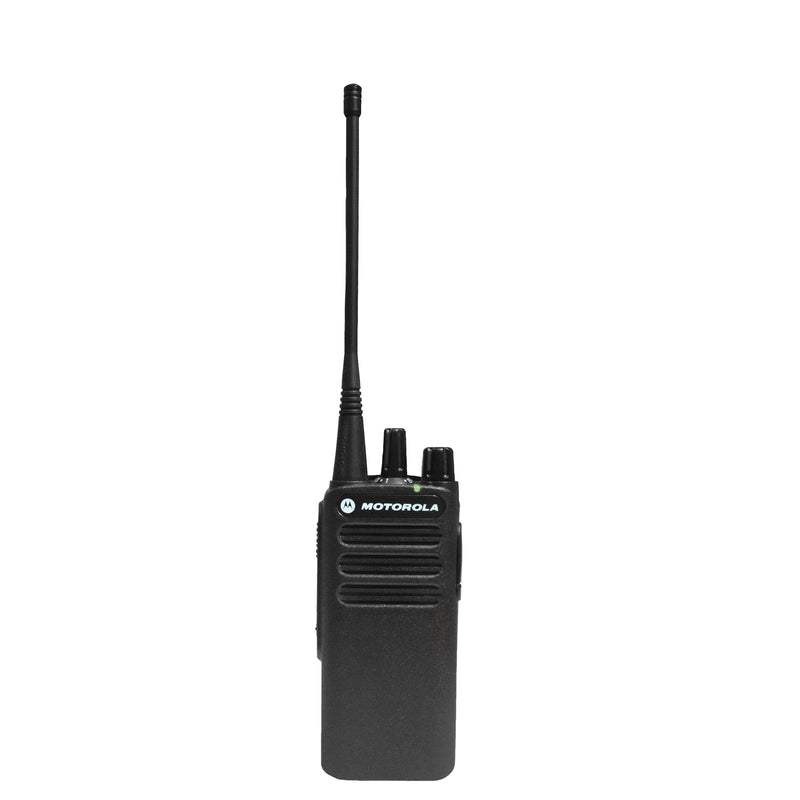
If your district needs radios in the hands of every teacher, custodian, and aide on a limited per-unit budget, the CP100d is where you start. It's Motorola's most affordable commercial-grade radio, and it punches well above its price.
It delivers 4 watts of UHF power (or 5 watts VHF), which translates to roughly 375,000 square feet of indoor coverage or 3-4 miles outdoors. It runs in both analog and digital modes, so it integrates with whatever you already have while giving you the option to unlock digital features (doubled channel capacity, clearer audio, 35% longer battery life) when you're ready.
For teachers who aren't "radio people," this matters: the CP100d is intentionally simple. No complex menus. No screen on the base model. One channel knob, one volume knob, one push-to-talk button. Voice announcements confirm channel changes audibly, so staff can stay focused on students instead of staring at a display. It's IP54 rated (dustproof and splashproof) and has passed Motorola's Accelerated Life Testing, a simulation of five years of daily abuse.
Where it fits on campus: Classroom teachers, custodial staff, cafeteria supervisors, front desk coordinators, substitute teachers. Available in 16-channel (no display) or 160-channel (limited keypad with display) configurations.
| Power Output | 4W (UHF) / 5W (VHF) |
| Channels | 16 or 160 |
| Battery Life | Up to 14.5 hrs (digital) |
| Durability | IP54, MIL-STD 810 |
| Modes | Analog + Digital (DMR) |
| Key Feature | Dual Capacity Direct Mode, doubles channels without a repeater |
Motorola SL300
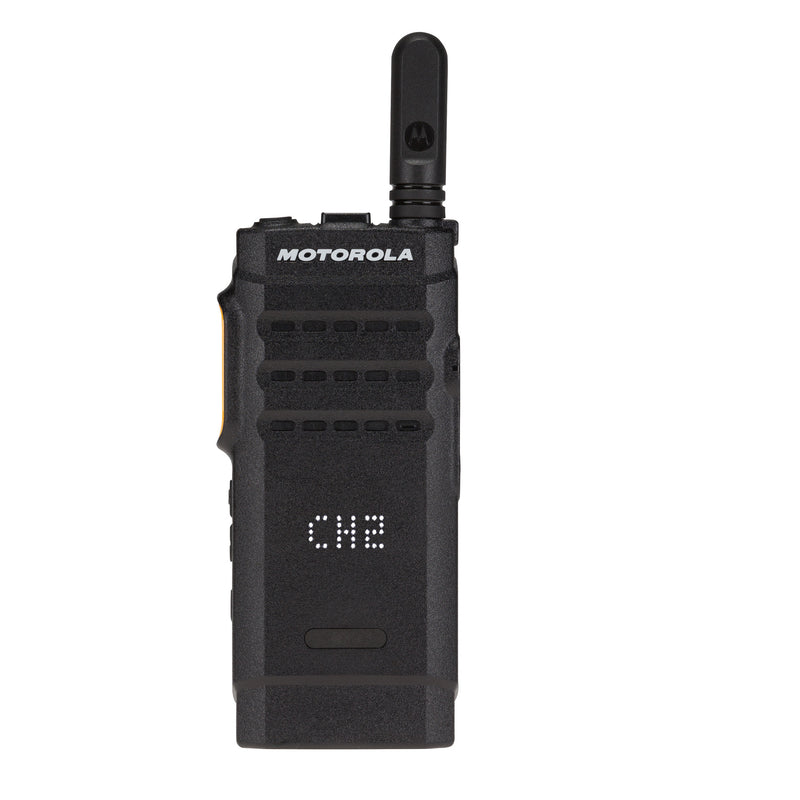
Here's a pattern we've seen for two decades. A district buys traditional handhelds for their administrators. The radios end up in a desk drawer because they're too bulky to carry between meetings, too conspicuous for parent-facing events, and too uncomfortable clipped to dress clothes. When you need to reach your assistant principal, they're three buildings away without a radio.
The SL300 solves the compliance problem that no spec sheet measures: will they actually carry it? At less than one inch thick and under 8 ounces, it disappears into a blazer pocket or clips discreetly to a belt. Motorola's patented Range Max antenna technology means that despite the slim profile, it delivers range rivaling radios twice its size. Roughly 325,000 square feet indoors or 30 floors.
It runs on MOTOTRBO digital with up to 99 channels, features a shatterproof Active View display (hidden LED matrix behind the housing), and supports transmit interrupt so your principal can break into any ongoing radio conversation for time-critical information. Battery life runs 12-15 hours on a single charge.
Where it fits on campus: Principals, assistant principals, front office administrators, guidance counselors, district superintendents visiting buildings, event coordinators, and anyone whose role requires them to be professional-facing while remaining reachable.
| Power Output | 3W |
| Channels | 2 or 99 |
| Battery Life | 12-15 hrs |
| Durability | IP54, MIL-STD 810D |
| Thickness | < 1 inch |
| Key Feature | Range Max antenna, full range in a pocket-sized body |
Motorola MOTOTRBO R5
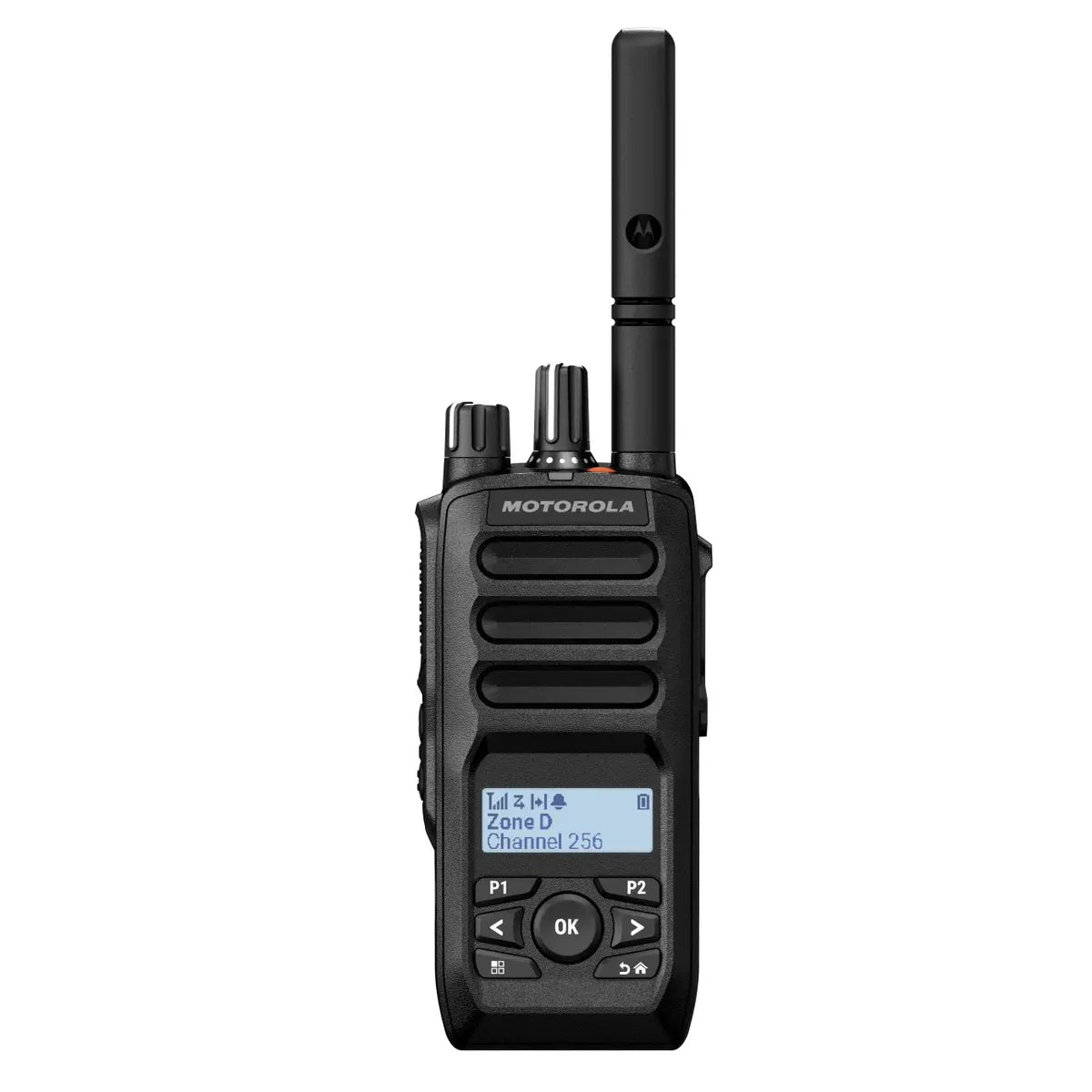
If you're upgrading your SRO, security team, or athletic department radios in 2026, the R5 is the new benchmark. Released by Motorola in early 2025 as the replacement for the XPR3000e series, it was designed with one guiding principle: the message gets through the first time, no matter the environment.
The R5's AI-trained noise suppression is its defining feature for schools. Software embedded in the radio distinguishes between the user's voice and ambient sound: cheering crowds at a pep rally, machinery in a shop class, traffic noise at a bus loop. It transmits only the voice. For the person receiving the call, the difference is dramatic. No asking "say again." No misheard locations during a crisis drill. Combined with a speaker rated up to 106 phons (with the extra-loud profile), the R5 cuts through cafeteria noise, gymnasium echoes, and outdoor wind.
Battery life is exceptional. Up to 32 hours on a single charge with the IMPRES battery system. That's two full school days without touching a charger, or one 16-hour event day (homecoming, graduation) with power to spare. The dedicated emergency button is a hardware key, not a software menu buried three clicks deep, so it's accessible under stress. For districts planning long-term, the R5 is upgradeable to Capacity Plus trunking and compatible with WAVE PTX for broadband push-to-talk.
IP67 rated (fully dustproof, waterproof, submersible). Built to MIL-STD 810. Available in UHF (4W) and VHF (5W) with 64 or 256 channels.
Where it fits on campus: School Resource Officers, security directors, athletic directors, facilities managers, event security, and any role that demands all-day reliability in high-noise environments.
| Power Output | 4W (UHF) / 5W (VHF) |
| Channels | 64 or 256 |
| Battery Life | Up to 32 hrs (IMPRES) |
| Durability | IP67, MIL-STD 810 |
| Noise Suppression | AI-trained algorithm |
| Key Feature | Emergency button + AI noise suppression + 32-hr battery |
Motorola TLK 25
Traditional two-way radios work within the range of their signal, typically a few miles and less inside buildings. That's fine for a single-building school. But what about the bus fleet? The district office across town? The athletic team traveling to an away game? The maintenance crew rotating between four campuses?
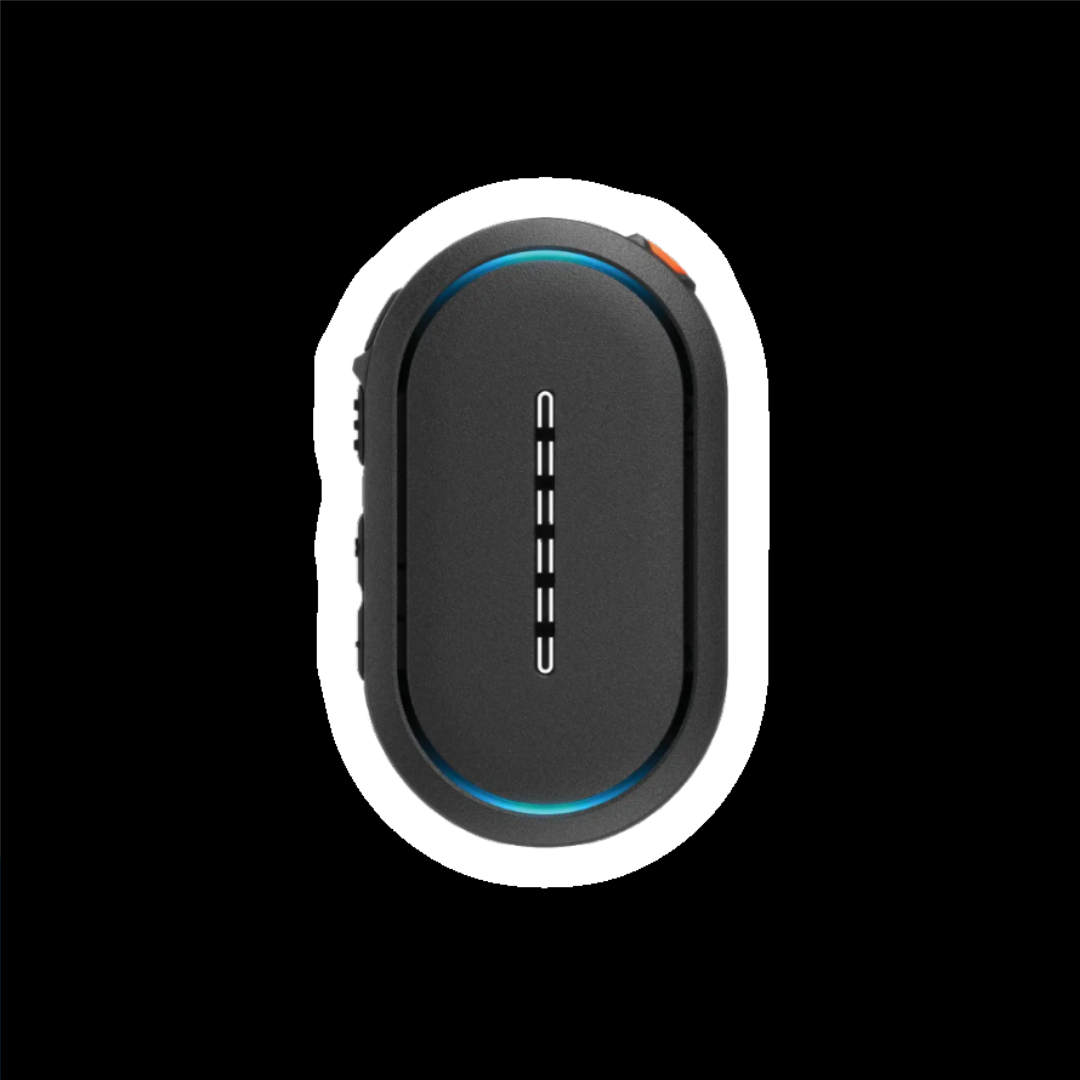
The TLK 25 removes the range limitation entirely. It's a push-to-talk device that communicates over LTE cellular networks and Wi-Fi, powered by Motorola's WAVE PTX cloud platform. Press the button, talk, and your message reaches anyone on the platform. Across the hall or across the state. No repeaters. No infrastructure. No FCC license required.
At 2.6 ounces and 0.74 inches thin, the TLK 25 is wearable. It clips to a lanyard, a belt, or a badge reel. It has no external speaker (communication happens through the included wired earpiece or any Bluetooth 5.0 accessory), making it completely discreet. The built-in voice assistant handles channel changes hands-free. And the dedicated SOS emergency button provides one-touch alerting with GPS location tracking on the LTE model.
For districts worried about interoperability: the TLK 25 works seamlessly with MOTOTRBO radios through WAVE PTX. Your SRO on an R5 can talk directly to a bus driver on a TLK 25 and a district administrator on the WAVE PTX mobile app, all on the same talkgroup. One ecosystem. No boundaries.
Where it fits on campus: Bus drivers, roaming district administrators, traveling coaches, multi-campus maintenance teams, and any role that needs push-to-talk beyond the reach of a traditional radio signal. Available in Wi-Fi only or LTE + Wi-Fi.
| Network | LTE + Wi-Fi (or Wi-Fi only) |
| Channels | 96 |
| Battery Life | 12-18 hrs |
| Durability | IP67, MIL-STD 810H |
| Weight | 2.6 oz |
| Key Feature | Nationwide push-to-talk, no FCC license, no repeaters |
HALO Smart Sensor 3C
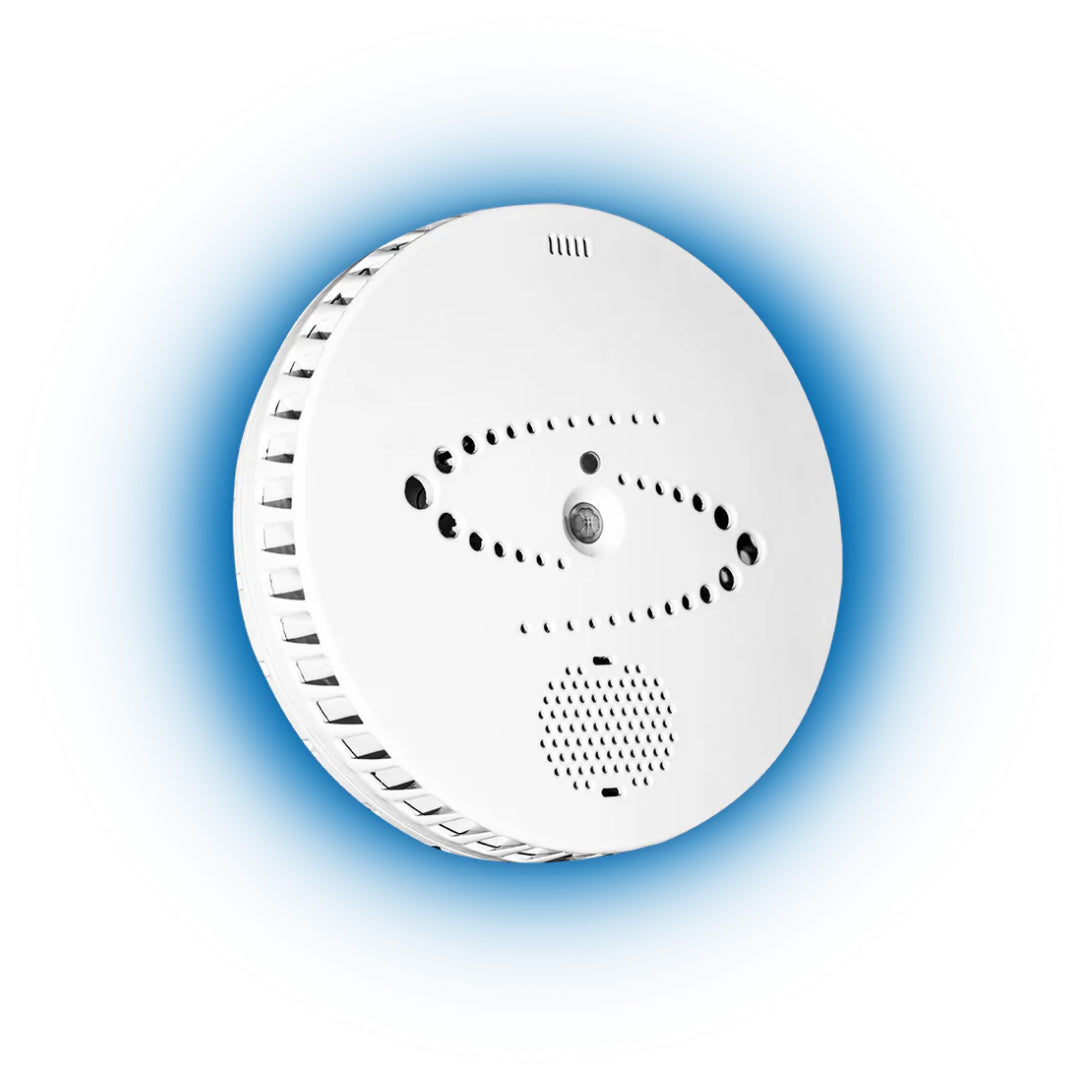
Radios connect your people. The HALO Smart Sensor protects the spaces between them: the bathrooms, locker rooms, and stairwells where cameras are legally prohibited but threats still happen.
HALO is a Motorola Solutions product designed specifically for privacy-sensitive areas. It does not use cameras. It does not record audio. It does not capture any personally identifiable information. What it does is monitor air quality and environmental conditions using over 12 integrated sensors, and when it detects something wrong, it alerts your staff instantly.
The detection capabilities are directly aligned with the threats administrators deal with daily. HALO detects vaping chemicals (including nicotine and THC), providing real-time alerts when students vape in restrooms. It detects smoke, hazardous chemicals, carbon monoxide, and volatile organic compounds. It monitors sound levels and can recognize aggressive shouting and specific spoken keywords. Its gunshot detection algorithm, using a patented dual-authentication system, identifies gunfire in 360 degrees within a 25-foot radius. That's roughly 2,000 square feet of coverage per sensor.
Each HALO 3C sensor includes multicolored LED emergency alerts (customizable by event type), motion detection, occupancy counting, and an integrated panic button feature. It connects to your existing security ecosystem through the HALO Cloud platform, which provides analytics dashboards, heat maps, and downloadable event reports.
Where it fits on campus: Bathrooms (the primary deployment location), locker rooms, vape-prone hallways, basement stairwells, and any privacy-protected area that needs environmental monitoring without video surveillance. One sensor covers roughly 144 square feet at standard ceiling height.
| Detection | Vape, THC, smoke, gunshot, aggression, air quality, chemicals |
| Coverage | ~144 sq ft per sensor (at 8 ft ceiling) |
| Privacy | No cameras, no audio recording, no PII captured |
| Power | PoE (Power over Ethernet) |
| Integration | HALO Cloud, Avigilon, VMS platforms |
| Key Feature | Gunshot + vape/THC detection + panic button in one device |
4. Beyond Radios: Building an Integrated Safety Ecosystem
A radio by itself is a communication tool. A radio integrated with your campus safety infrastructure is a response system. The difference is what separates a school that has safety equipment from one that executes a safety plan.
Modern school safety architecture connects three layers that need to talk to each other in real time.
The first layer is immediate voice communication, your radio fleet (the CP100d, SL300, R5, and TLK 25 covered above). This is how your people coordinate moment-to-moment during normal operations and during crises. The second layer is mass notification, your PA system, IP-based paging (platforms like Singlewire InformaCast or Alertus), and emergency alert triggers. Some of these systems can now be activated directly from a handheld radio, triggering school-wide lockdown announcements from the SRO's R5 without returning to the front office. The third layer is environmental monitoring, the HALO Smart Sensor covering the spaces your cameras and radios can't reach, feeding real-time data to your security dashboard.
When these three layers connect, the response chain tightens dramatically. A HALO sensor detects a gunshot in a second-floor restroom. The alert fires to the security dashboard and the SRO's radio simultaneously. The SRO triggers a lockdown on the PA system from their handheld. Teachers on CP100d radios receive the lockdown confirmation on their channel. The front office relays building and floor data to responding officers. The TLK 25 on the bus loop notifies drivers to hold buses and block the parking lot exit. That entire sequence can happen in under 60 seconds if the system was built for it.
If your radios, your PA, and your sensors exist as three separate, unconnected purchases, that sequence doesn't happen. Your staff reverts to running down hallways, calling 911 on personal cell phones, and hoping the message gets where it needs to go.
UHF vs. VHF: Matching Frequency to Campus Layout
One technical decision has outsized impact on campus communication quality: the frequency band your radios operate on.
UHF (Ultra High Frequency, 400-512 MHz) is the right choice for most school environments. UHF waves are shorter, which means they penetrate walls, floors, concrete, and brick more effectively. For a multi-story school building with interior classrooms, a gymnasium, and a basement, UHF provides consistently better in-building coverage.
VHF (Very High Frequency, 136-174 MHz) has longer waves that travel farther in open space but struggle with building penetration. VHF is better for campuses that are sprawling and outdoor-heavy: large athletic complexes, agricultural programs, rural districts where buildings are spread across significant acreage.
Many districts need both. We commonly deploy UHF for indoor staff (administration, teachers, security) and VHF for outdoor-heavy roles (grounds crew, athletic fields, bus operations), programmed to interoperate on shared channels. If you're unsure which band fits your campus, that's exactly the kind of assessment we do before a single radio ships.
5. Funding It: The Grants That Pay for This
This is where most school administrators hit a wall. Not because the need isn't obvious, but because the budget isn't there. What most administrators don't realize is that federal funding specifically designed for school communication upgrades has been available for years. Two-way radios are explicitly listed as an approved expenditure. The money exists. The challenge is knowing which grant to apply for and how to position your application.
Critical distinction: There are two major federal grant programs funded under the STOP School Violence Act of 2018. They share a name and a purpose, but they fund different things. Confusing them is one of the most common mistakes in school safety grant applications.
COPS SVPP: The Grant That Buys Radios
The School Violence Prevention Program (SVPP), administered by the COPS Office at the U.S. Department of Justice, funds physical security and technology upgrades. This is where two-way radios, panic alert systems, cameras, access control, and emergency notification technology are approved expenditures. The FY25 cycle distributed over $74 million to 211 recipients, with awards up to $500,000 per recipient over a 36-month performance period. The program requires a 25% local cash match (the federal grant covers 75%), though match waivers are available for qualifying agencies. Microgrants of up to $100,000 are reserved for rural, tribal, and low-resourced schools with the match requirement waived entirely.
Eligible applicants include states, units of local government, Indian tribes, and their public agencies, including school districts, public boards of education, police departments, and sheriffs' departments. Individual schools that don't operate as their own district typically apply through their district or a partnering law enforcement agency.
For your grant narrative, the language that matters is: "technology for expedited notification of local law enforcement during an emergency." That's the statutory purpose area that covers two-way radios, and it's the phrase your application should reference directly.
BJA STOP School Violence: The Grant That Funds Training (Not Hardware)
The Bureau of Justice Assistance (BJA) also administers grants under the STOP School Violence Act, but with a fundamentally different focus. BJA STOP funds training programs, threat assessment teams, anonymous reporting systems, school climate initiatives, and behavioral intervention. The FY25 cycle offered $83 million with awards up to $2 million for state-level programs and $1 million for local programs.
Here's the critical point: BJA STOP funds cannot be used to purchase physical security equipment. No cameras. No security systems. No radios. If you need to fund hardware, apply to COPS SVPP. If you need to fund training and behavioral threat assessment programs, apply to BJA STOP. Many districts benefit from applying to both, using SVPP for the communication infrastructure and BJA STOP for the personnel training that makes the infrastructure effective.
State-Level Funding
Many states also run their own school safety grant programs. Florida provides $6.4 million annually in recurring state funding for Alyssa's Law-compliant panic alert systems, plus $14 million through HB 301 for school mapping data. Tennessee allocated $40 million in school safety grants for the 2023-2024 fiscal year. Ohio proposed $25 million through HB 106. Washington appropriated $6 million for school security grants for 2025-2026. Oregon's Wireless Panic Alarm Grant provides up to $2,000 per school.
These programs cycle annually. We maintain relationships with districts across the country and track these windows closely. If you need help identifying which grants your district qualifies for, we'll walk through the options with you. No obligation, no sales pitch.
6. The 10-Point Campus Communication Audit
Before you spend a dollar on new equipment, you need to know where your current system is failing. This is the abbreviated version of the site assessment we perform for districts. Walk your campus with your SRO or security director and answer these honestly.
1. Dead Zone Test. Have one person stand in the basement stairwell furthest from the front office. Have another stand at the farthest outdoor point on campus (athletic fields, bus loop, portables). Conduct a radio check from the front office. Can you hear both clearly? If not, you have a coverage gap that matters during an emergency.
2. Simultaneous Load Test. During dismissal (the most radio-intensive 20 minutes of your day), have three staff members try to transmit at the same time. Are channels jammed? Are people waiting to talk? If so, you need either more channels or TDMA digital radios that double your capacity.
3. Battery Endurance Audit. Charge every radio to full at 7:00 AM. Check battery levels at 3:00 PM. If any radio is below 20%, it won't survive an after-school event, an emergency that extends into overtime, or a day where someone forgot to dock it the night before.
4. Carry Compliance Count. Walk the building at 10:00 AM on a random Wednesday. How many staff members who are assigned a radio actually have it on their person? If the answer is less than 80%, the problem isn't the staff. It's the radio. It's too heavy, too bulky, or too inconvenient to carry.
5. Licensing Verification. Pull your FCC license documentation. If you can't find it, or if the radios in your building aren't matched to licensed frequencies, you have a compliance gap.
6. Encryption Check. Can your radio transmissions be picked up by a consumer scanner? If you're operating on analog without encryption, the answer is yes. During a security incident, that's an information leak to anyone listening.
7. Emergency Button Inventory. How many of your current radios have a dedicated, physical emergency button? Not a menu option. A button. In a crisis, fine motor skills degrade. A hardware emergency key that can be pressed through fabric, in the dark, without looking at the radio, is a safety feature that software can't replace.
8. Integration Assessment. Does your radio system connect to your PA, your alert system, or your security platform in any way? Or does it operate in complete isolation?
9. Privacy Area Coverage. What monitoring exists in your bathrooms, locker rooms, and other camera-prohibited spaces? If the answer is "none," you have zero situational awareness in the locations where vaping, bullying, and concealment are most likely to occur.
10. Grant Readiness. If a COPS SVPP application window opened tomorrow, could you submit within 45 days? Do you have a current safety plan, a vulnerability assessment, a law enforcement partnership letter, and a clear budget narrative for communication technology? If not, you're not grant-ready, and the next cycle will pass you by.
If you scored yourself honestly on all ten points and found gaps, you're not alone. Most schools we audit score well on two or three and have significant vulnerabilities on the rest. The good news: every gap on this list has a clear, fundable solution.
7. Your Next Step
You just read 3,000+ words about what your school's communication system needs to look like in 2026. Here's the honest summary of where you probably stand: your current radios are partially working, partially sitting in drawers, and fully unprepared for the compliance demands, coverage expectations, and safety scenarios headed your way. Whether that's an Alyssa's Law mandate in your state, a COPS SVPP grant cycle you could leverage, or an emergency that tests every system you have.
We've been an authorized Motorola Solutions dealer for over 25 years. We program every radio to your campus frequencies before it ships. We handle FCC licensing. We build fleet quotes for districts of every size, from a 6-radio elementary school to a 200-radio multi-campus district. And we don't charge for the conversation that helps you figure out what you actually need.
Get a Custom Campus Communication Assessment
Tell us your district size, your current radio inventory, and your biggest communication pain point. We'll build a recommendation with specific models, quantities, programming details, and grant-eligible pricing within 48 hours.
Request Your Free Campus Assessment Call Us: 1-800-984-1534TwoWayRadioGear.com is an authorized Motorola Solutions dealer. All products include manufacturer warranty and are eligible for Motorola's service and support programs. We assist with FCC licensing, custom programming, fleet deployment, and grant-eligible quoting for K-12 districts nationwide.