
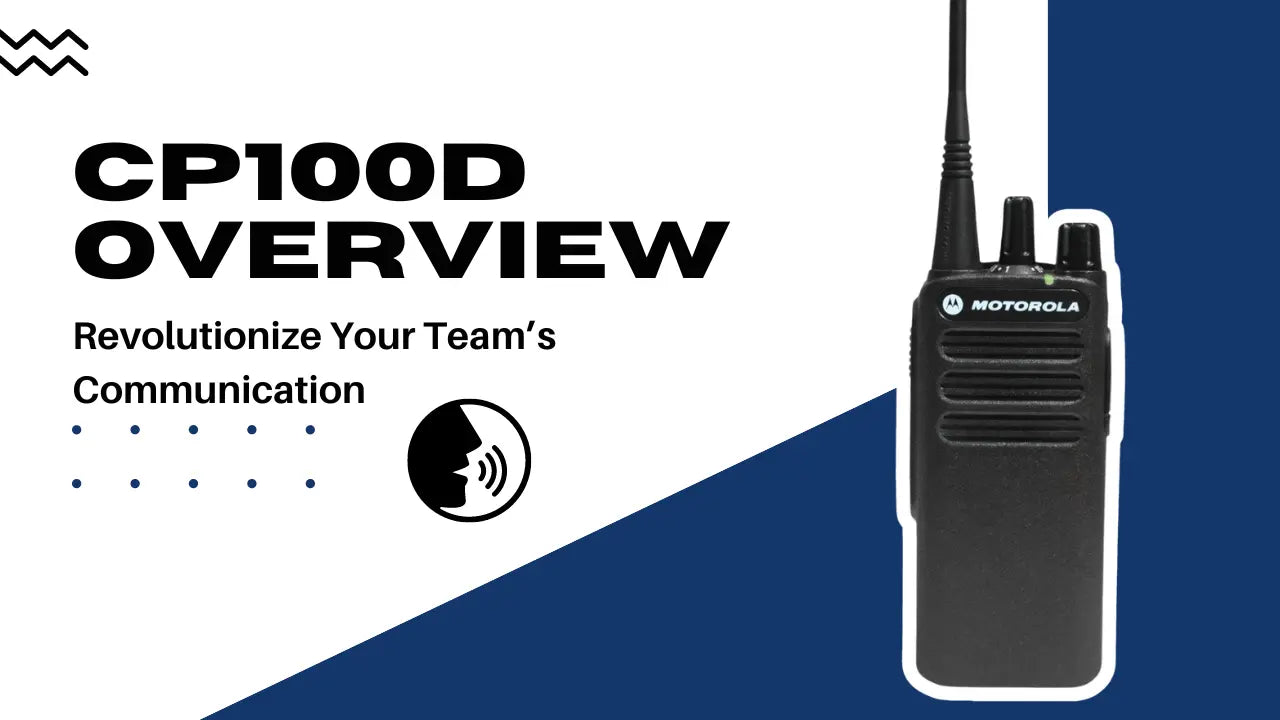
When you outfit a team with radios, the real question is fit: will the same handheld hold up on a job site, in a hotel corridor, and behind an event stage? The Motorola CP200d built its reputation on exactly that kind of range. Let’s look at where this MOTOTRBO portable earns its keep across different industries.

What Makes the CP200d Versatile?
The Motorola CP200d is part of the MOTOTRBO family, which means it can operate in both analog and digital modes. Teams still running older analog fleets can put CP200d radios on the same channels today and migrate them to digital later, without buying hardware twice. That migration path is a large part of why so many organizations standardized on this radio: the upgrade happens on the organization’s schedule, not the equipment’s.
It is also a deliberately simple radio. With 16 channels, a top-mounted channel knob, and a rugged, no-display design, the CP200d asks very little of the person carrying it. A staff member who has never touched a two-way radio can be handed one at the start of a shift and be productive immediately — a quality that matters just as much in a stadium concourse as it does on a scaffold.
Key Features of the CP200d
In digital mode the CP200d draws on core MOTOTRBO capabilities. Dual Capacity Direct Mode carries two voice paths on a single channel without a repeater, so a growing crew doesn’t automatically mean new frequencies. Transmit Interrupt lets a supervisor break into ongoing traffic when something urgent has to get through — a feature that safety teams in particular lean on. Digital operation also brings clearer audio toward the edge of coverage and longer battery life across a working shift.
The radio’s physical design backs those features up. The CP200d meets the IP54 rating for dust and splashing water, and its housing is built for years of daily clip-on, toss-in-the-bin treatment. Batch programming support means a fleet of these radios can be configured consistently from standardized templates, which keeps large deployments in warehouses, schools, and security operations uniform and easy to maintain.
Industries That Rely on the CP200d
Construction crews are the classic CP200d users. Sites are loud, dusty, and spread out, and the radio’s straightforward controls work even through gloves. Foremen coordinate deliveries, flag hazards, and keep trades in sequence without anyone pulling out a phone. Warehousing and manufacturing teams use it the same way — wide floors, high noise, and shift workers who need communication that just works.
In hospitality, the CP200d keeps front desk, housekeeping, banquets, and engineering on the same page without guests ever hearing a page over a speaker. A housekeeping supervisor can turn a room minutes faster when the request arrives by radio instead of a callback, and that speed shows up directly in guest satisfaction scores.
Event management and event security round out the picture. During a large event, setup crews, gate staff, and security teams each get their own channel, and coordinators move between them from a single radio. Schools use the CP200d across campuses for the same reason: front office, maintenance, and playground supervision all stay reachable on one simple device.
Adapting the CP200d to Specific Needs
The CP200d comes in UHF and VHF band versions, so it can be matched to the environment: UHF is the usual choice in and around buildings, while VHF favors open outdoor ground. From there, the fit is fine-tuned with accessories — earpieces for discreet security work, remote speaker microphones for gloved hands, multi-unit chargers for shift changes, and spare batteries to keep a fleet turning. You can browse the full range in our CP200d accessories collection.
Because the radio can start in analog and switch to digital when the rest of the fleet is ready, organizations can pace the transition to match their budgets. Many CP200d fleets in the field today began life alongside older analog radios and moved to digital one department at a time.
A Proven Radio — and Its Successor
In short, the Motorola CP200d is a dependable, easy-to-run portable that has proven itself in construction, hospitality, events, education, and security alike. Its analog-digital flexibility and simple 16-channel design are why it became a fixture in business radio fleets across North America. Motorola has since positioned the MOTOTRBO R2 as the CP200d’s successor, so if you are standardizing a new fleet today, the R2 is the natural next step — and if you are supporting an existing CP200d fleet, the accessories and migration path above will keep it working hard for years.