
Sprint shut down the original US Nextel iDEN network on June 30, 2013. Its familiar Direct Connect service depended on that network, so an old Nextel iDEN phone cannot be reactivated on the original service today. The button-driven group communication that businesses valued lives on through newer push-to-talk systems. For teams spread across towns or routes, compare broadband push-to-talk using dedicated devices or an app. For a single site, conventional radios may be the better fit.
The shutdown date is documented in Sprint's second-quarter 2013 investor update filed with the SEC. This guide concerns that original US network. A later product or service using similar branding should be evaluated on its actual network, provider and support rather than assumed to restore legacy iDEN service.
What happened to Nextel Direct Connect?
Direct Connect made it easy to reach a coworker or group without dialing individual phone calls. That workflow suited mobile crews, dispatchers and businesses whose employees were in different places. The handheld was part of a carrier network, not an ordinary radio that reached every other unit directly across the country.
When Sprint retired the Nextel platform, the original network-dependent service ended. The value of immediate group communication did not disappear. Newer services perform that job over supported broadband networks, while traditional two-way radio systems continue to serve local sites and engineered coverage areas.
A short timeline
| Period | What it means for a buyer |
|---|---|
| Original Nextel iDEN era | Direct Connect provided carrier-based push-to-talk for business users |
| June 30, 2013 | Sprint shut down the original US Nextel network |
| Replacement planning today | Choose the current network, devices, service and support that fit your operation |
Buying a used iDEN handset does not bring back the retired network. Confirm current service eligibility with the provider before spending money on any legacy device. For a business deployment, start from today's coverage and workflow requirements rather than trying to recreate a particular old handset.
What replaces the old push-to-talk workflow?
Broadband push-to-talk, often called push-to-talk over cellular, connects supported devices through a service. A user selects a talkgroup and presses the talk button to reach the group. The service manages users and group membership; it also requires supported connectivity and appropriate subscriptions.
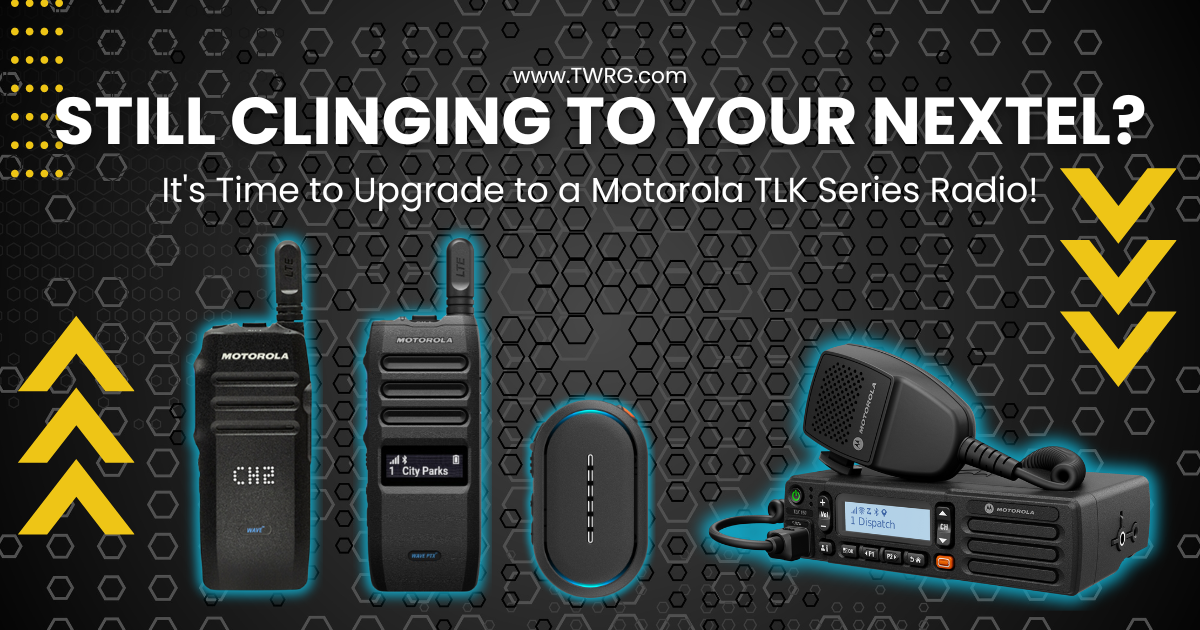
Motorola WAVE PTX is one option to evaluate. It supports a mix of dedicated devices and software clients. This is a replacement approach for the group communication task, not a reactivation of the original Nextel network.
Dedicated handhelds: TLK 110
Compare a Motorola TLK 110 when employees need a dedicated push-to-talk device rather than a general-purpose phone. Scope the supported service, talkgroups, charging and accessories together. Test the places where staff actually work, including indoor dead spots and their normal routes.
Vehicle communication: TLK 150
The TLK 150 is a vehicle-oriented option. Motorola's US TLK 150 page describes a dedicated push-to-talk microphone, Wi-Fi connectivity and WAVE PTX integration. Include installation, power, antenna placement and approved accessories in the deployment plan. Set a safe-use policy for drivers.
Staff already carrying phones: WAVE PTX app
The WAVE PTX app may fit supervisors or occasional users with supported smartphones. Confirm subscriptions, permissions, background operation, audio accessories and the company policy for personal devices. Include those users in the pilot rather than assuming every phone behaves like a dedicated radio.
Nationwide coverage still has limits
Nationwide is a service footprint, not a promise that a device works in every basement, remote road or emergency. Review the TLK coverage information, then confirm supported networks and subscription terms for the exact US configuration. Test the actual service, not just the signal indicator on an unrelated phone.
Where Wi-Fi is part of the supported setup, assess its coverage, access and reliability. A network outage or service interruption can affect broadband push-to-talk. If communications are critical, plan a separate fallback and tell staff when to use it. Ask about account administration, replacing a lost device and removing a departed employee's access.
When on-site two-way radios are the better choice
A store, warehouse or campus may need direct local communication more than a wide-area service. Conventional on-site radios communicate within their designed coverage and can avoid a cellular subscription for basic radio-to-radio operation. A compatible licensed system and repeater can address a larger or obstructed site.
Compare the ongoing service cost and network dependencies with the cost of local radios, licensing and any repeater infrastructure. Our on-site versus nationwide radio guide covers that choice. A business with local staff and mobile crews may need both, with any interoperability confirmed and configured rather than assumed.
Plan a replacement around the crew
List users by role: dispatcher, driver, field employee, supervisor and occasional app user. Define who needs to hear each talkgroup and who can speak across groups. Then pilot a representative mix of devices on the worst routes and busiest shifts. Test intelligible group calls, battery and charging routines, accessories and the process for adding or removing staff.
Request a quote separating devices, vehicle installation, accessories, subscriptions, setup and support. Confirm what happens if coverage fails at a required location and who handles troubleshooting. For towing and mobile teams, test both the dispatcher-to-driver path and communication among crews.
Request a push-to-talk replacement recommendation with your user count, vehicle count, operating area and existing equipment. Browse nationwide two-way radios to compare current options. The objective is a supported communication workflow your team can use today.
Frequently asked questions
Do original Nextel phones still work on Direct Connect?
The original US Nextel iDEN network was shut down in 2013. An old iDEN handset cannot be reactivated on that retired network. Evaluate any later branded service separately with its actual provider.
When did Nextel shut down?
Sprint shut down the original US Nextel network on June 30, 2013, as documented in its second-quarter 2013 investor update.
What replaced Nextel Direct Connect?
There is no single replacement for every business. Current broadband push-to-talk services, dedicated devices, smartphone apps and on-site radio systems can perform the group communication task.
Is there a Nextel-style radio that works nationwide?
Dedicated devices such as Motorola TLK radios with WAVE PTX provide broadband push-to-talk across supported service coverage. An active subscription and suitable network connection are required; coverage is not universal.
Do nationwide push-to-talk radios need an FCC license?
Users do not need an individual FCC business radio license for cellular push-to-talk operation. They do need the appropriate service plan. Conventional business radio systems and any integrated licensed radio components have their own licensing requirements.